Neverending Story: Upcoming Projects 😍
- Fix “Call the cabin to turn up the heat”
- Battery protection by automatically disconnecting the 220V supply from the 12V supply
- Monitoring of fuel and water tanks
- Internet (via Starlink or the mobile network?)
- Status display
- Turn on the heating cables on the water tank from home
- Automatically open the gate for people other than me
A quick rundown of what’s in the pipeline. A lot of it has to do with home automation, ESP32, Shelly, etc.
Fix “Call the cabin to turn up the heat”
From the time the cabin was built in 1994 until the pager network was shut down in 1997, we had a “Call the Cabin” feature on the Wallas. Regular cell service didn’t reach that far. Around 2024, “LTE-M” solutions began to emerge: LTE (4G) running on the old 450 MHz cellular network, which penetrates much deeper into the mountainous terrain.
Our paraffin stove from the Finnish company Wallas is perfect when it works. Over the past 5–6 years, however, it hasn’t been very cooperative, but in 2024/25 it was refurbished internally (new circuit board, burner, etc.) so that the 20-year-old stove is essentially electronically equivalent to a new one. This enables “Ring hytta varm” using a Sikom box I purchased. I hooked everything up according to the manual this summer, but… it didn’t work. I’ll try again next summer.
Battery protection by automatically disconnecting the 220V supply from the 12V supply
After spending a lot of time experimenting with ChatGPT before Christmas, I’ve come to the conclusion that I basically need to rewire the electrical system 😄 That is, everythingworkstoday, but I can achieve a lot by connecting things like this:
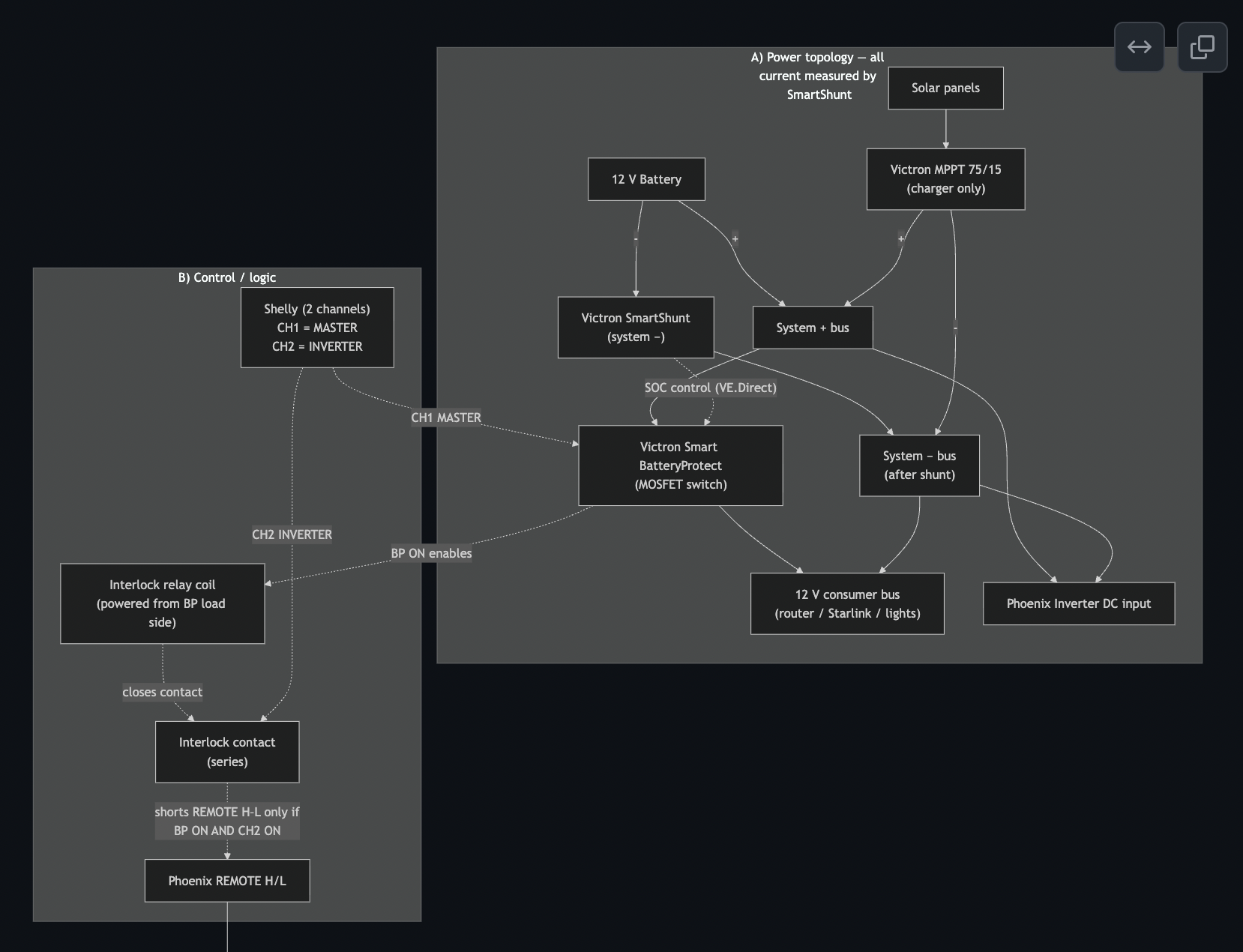
Then I'll get
- Improved architecture: everything runs through a single common DC bus—and all current must pass through the shunt.
- Complete overview of power consumption via Victron SmartShunt
- BatteryProtect physically cuts off 12 V power to the load. This, in turn, will automatically shut off the 220 V power supply!
- emergency power switch
Monitoring of fuel and water tanks
It doesn’t take much to build a small device that uses ultrasonic sensors to measure the water level in a tank. The idea is to use a couple of these in the fuel tank of the Wallas and in the water tank, connect them to an LTE-M gateway via LoRa, and push the data to the internet. Then you can check the status directly from the website 🤓 All you need to do is create some “Edge Functions” in Netlify to receive and display the data.
- LoRa (short for “Long Range”) is a wireless radio technology developed by Semtech for long-range communication with extremely low power consumption. It is a cornerstone of IoT (Internet of Things) applications and enables data transmission over many kilometers; it is frequently used in smart cities, agriculture, and industry.
- An Arduino-compatible ESP32, an inexpensive LoRa module, and an ultrasonic sensor cost around 200 kr. With deep sleep mode and waking up once an hour, they should easily last a year without needing a new battery.
Internet (via Starlink or the mobile network?)
We’ve had a satellite dish from Allente (Canal Digital) for a long time, but it costs an absolute fortune and the dish often went out of alignment. Now we have a cable outage, and I had to consider whether it made sense to keep paying 700 kr/month for something very few people use. Many people would like to stream TV shows and series, but we don’t have 4G coverage.
I had been planning a major project for quite some time (fall 2021) that involved running cables to the nearest peak and installing a 4G antenna with Power-over-Ethernet and a lot of custom electronics to make it work, but then the roof blew off and I had to prioritize more important things …
Starlink
Then Starlink emerged as a viable alternative. For a long time, it cost 1,000 kroner a month, but now it’s available for half the price Allente was going to charge … Reliable, fast, and affordable.
The downside is high power consumption: it draws over 100 watts during startup before dropping to less than 30 watts once it has stabilized. 2 amps is still far too much (50 Ah/day) to be manageable in the winter, especially if we were to forget to turn it off, so this requires two things:
- Automatic disconnection from 220V (see above) so we don't drain the batteries
- Ability to turn the 220V power on and off using wall switches
I’ll probably also have to build my own low-power, LTE-M/IoT-based device to be able to control everything else remotely. I might connect the remote starter to the Wallas (which is LTE-M-based and has two relays that can be used to control other devices).
What about the mobile network?
In short, the original idea was
- Industrial 4G router (RUT241), possibly built into the antenna housing to minimize signal loss
- 200 m of CAT5 cable running down to the cabin, with an amplifier installed after 100 m (Power over Ethernet)
- Can be powered by a custom-built 24V/48V power supply from a 12V source
- Set up a mast on a tripod up in the mountains where there is cell service
- Approximate cost: 7,000–8,000 NOK?
Quite a complex outdoor setup and relatively high cost, but relatively simple indoors due to low power consumption (220V not required).
Conclusion (May 2025)
I think I'll go with 4G-based internet anyway, for the following reasons:
- 4G can be more affordable than I thought: I already had a Poynting LDPA-92 duplex, directional/Yagi antenna. You can't get much better than that, but it's quite large and requires a sturdy mount with a rock-solid foundation. I also don’t need a separate subscription: I just use a data SIM on my own plan.
- I don't need to build as many custom components as I thought. I've found off-the-shelf 12V PoE injectors and most of the other parts I need.
- Starlink looks simple on the outside, but it’s actually quite complex on the inside when you have a 12V system that remains out of sight most of the time.
- With 4G, I don't have to use an ultra-low-power mode just to connect to the regular internet.
I've already bought the mountain mount for the mast, the mast itself, and the antenna mount. All I need is to get a 12V-48V PoE injector -> cable -> 48V outdoor Ethernet extender with PoE -> cable -> PoE splitter -> 12V plug for the router. That is, a box at each end. Plus plastic enclosures for weather protection 🙂
Expected to be ready by late summer 2026!
Status display
It would be cool if there were a display at the cabin that showed:
- whether the current draw was low or high
- whether a large/small/normal amount of water was used, and an estimate of the remaining amount based on consumption
- Levels of water and diesel/kerosene
Turn on the heating cables on the water tank from home
Requires:
- LTE-M remote starter (model NRF9151) capable of receiving commands and initiating actions over the network (asynchronous architecture)
- LoRa transmitters on the devices that allow us to use the automatic 220V and 12V disconnection setup to start the Victron inverter.
- Wi-Fi router/Starlink
Automatically open the gate for people other than me
Right now, I have to be there in person whenever guests come to the cabin so I can open the gate. It’s a pain. Only my registered phone number works. But what if I could have someone else control one of my phones? 🤔
My approach: create aAndroid app that makes callswhen it receives a signal. It doesn't even need a backend—it just needs to be able to read text messages or receive a call. The signal can be
- Text message: “Open Sesame”
- Someone is calling
- A WebSocket to a server or edge node sends a signal (similar to
{action: 'open-gate'}).