220V in the outlet
This weekend, I had an electrician go over all the electrical work I’d done myself this summer. It wasn’t enough for him to just check that everything was OK: he ended up opening up the wall and running all the exposed cables inside it. Suddenly, all the holes in the exterior wall and the 30 meters of cable running out from and under the cabin were no longer necessary… whoops, Swiss cheese for nothing 🙈
At least the installation is now complete, and I can finally go through the cabin guide and update it, because now the extension cord no longer runs from the loft—it’s inside the wall! To use the TV or the vacuum cleaner, all you have to do is turn on the power strip :)
The Wallas (paraffin heater) turned out to have a defect I couldn't fix myself, so it has to be taken down before Christmas for repairs. Oh, well. No one's coming to visit before then.
Summary of the Electrical System
Without getting into the math, in practice I have enough energy to last 5–6 days without sunlight at a consumption rate of 1,000 Wh (which is relatively high) before I need to start the generator at50%. When the sun is shining brightly, I charge at a maximum of about 1000W/67A (860W + 140W). That’s more than the generator (50A)! In foggy conditions, it charges up to 100W (at least half of which comes from the old system!)
- four timesConcorde Sun Xtender PVX-2580L(258Ah@C20, 305Ah@C100)
- 1x Varta 136Ah
- All batteries connected in parallel (12V)
- 3 x 330W solar panels connected in series on the roof (120V) and 1 x 140W panel mounted vertically facing south (approx. 18V)
- “China-made inverter” rated at 1000W continuous (2000W peak)
- Victron 250V/60A(for new panels) andVictron 75/15(too old). Both MPPT.
- Canadus HD-1224desulfates for maximum battery life
A little longer and more boring
I originally had just one Sun Xtender battery. This model is a type of “deep-cycle” battery that is particularly robust; it’s designed to withstand cold temperatures and very deep discharges without being damaged. It also weighs nearly 80 kg!
It’s probably from 2013 or earlier, but it’s in great shape: I had it tested at Sunwind in 2018 and it was at 98% of its original capacity. I then bought an extra Varta battery after some tenants ran out of power and had trouble recharging the battery. It was really just meant to be a backup, but it’s now part of the setup. I then bought another used Sun Xtender, but it turned out to be a bad buy. It was very worn out; I measured it at60% capacityand with very poor performance (couldn't handle 300W for 30 minutes). In addition, I've bought two more Sun Xtenders—also used—but I measured these at> 90 percent capacity.
So with the old batteries, I estimate a theoretical capacity of about 1000 Ah, but since the batteries shouldn't ideally be discharged below 50% (and ideally kept above 70%), that comes out toin practice500 Ah at 12 V or 6,000 Wh.
Why used batteries
Cost and time considerations. I needed to increase the battery capacity at the cabin and realized that buying a new battery pack would be very expensive. As of 2019, lithium batteries were not yet competitive in terms ofprice (but almost!), even though in practice you only need half as much capacity with lithium since they can be fully discharged. I realized, however, that lithium batteries will be “the right”/most economical choice in just a couple of years. By then, it might make sense to upgrade to 48V while I’m at it. At the same time, I had two AGM batteries that were practically new—it would be a waste to just throw them away, so I looked into ways to use what I had and get the capacity I needed in a cost-effective way. A new PVX-2580 costs about 12,000 kr (10K on sale). I managed to buy 3 units for 9,000 kr with an average capacity of 80%. In other words, almost a 70% discount on Ah/kr. In total, it came tothe upgradefor the system, including solar panels, cables, controllers, mounting hardware, and several batteries, for about 25,000 kr. That’s much cheaper than what I found online.
It is generally not recommended to mix batteries of different types, models, or years, etc. However, it isIt is very important that the batteries are identical when connecting them in seriesthem, but it isn'tsoThis is important when connecting batteries in parallel. Even a worn-out battery can be beneficial when connected in parallel, as long as the voltage curve and peak voltage are relatively similar. If they aren’t, differences in resistance between the batteries can cause the load to be uneven. This results in a shorter battery life. For my part, I saw that this wouldn’t be a major problem: I have nearly identical batteries, the current draw is low (2–5 A), and since I have so much power on the charging side, the batteries will almost always be >95% charged. That keeps wear and tear to a minimum. Since I’m looking at a 5-year timeframe, I think this will work out just fine.
Addendum: Price Notes
The price per kWh has reportedly fallen by 82% from 2012 to 2020, or by 90% from2008 to 2022and mustfor 2023be approximately $150/kWh. By 2030, the price is expected to be about half that again: $75/kWh.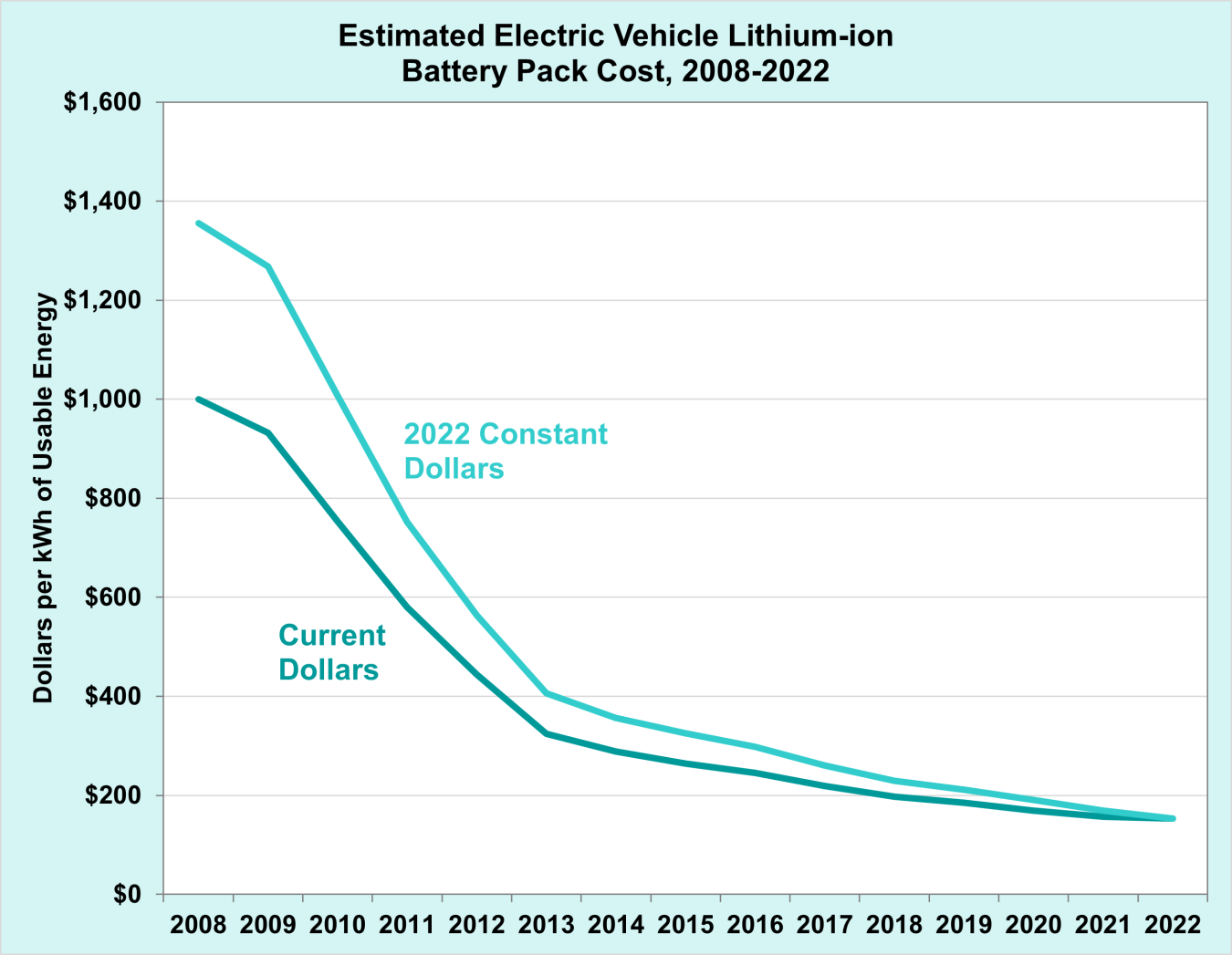 . We can assume that the price in 2019 was likely equivalent to $200/kWh, so at today's prices, upgrading to LiPo or other options is a no-brainer.
References
- 50% = 12.2V - refSun Xtender Technical Manual, Appendix C