2024: Freediving for Freedom
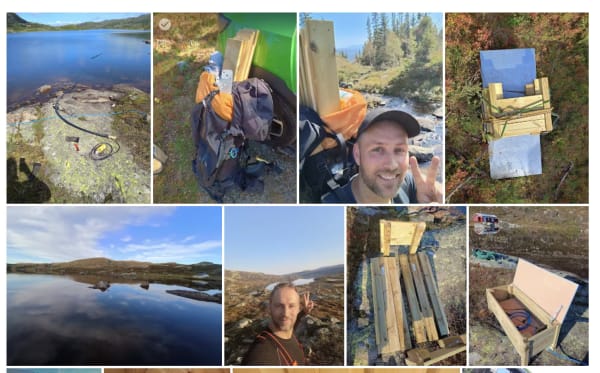
After talking to the last people who rented the cabin, I realized that quite a few people actually find it kind of fun to read about the technical stuff we do, and I see that I’ve actually forgotten to write anything about one of the bigger infrastructure upgrades I’ve done recently. So I’ve put together aA short photo story in Google Photosfrom the transport of pumps by snowmobile in the winter of 2024 to the full operation of the heat cables with pumping on November 30, 2024.
The Odyssey
In the winter of 2023/2024, I started looking into ways to make refilling the water supply at the cabin during the winter a bit easier. Setting up pumps, water hoses, and so on during the winter was quite a hassle, and over time we’d accumulated quite a few “funny” (#fail) stories. I wanted something that others could also manage to fill up during the winter, without too much effort or hassle.
In short:
- I got a tip about a good-quality submersible pump (EMS Technology, P2101, approx. 12,000 kr),
- gotVaria Metal Workshop in Skyttato build a custom stand (4,000 kr)
- had to transport freediving gear (including a weight belt and ABC gear), a pump, heating cables, and 50 meters of PU tubing during the winter by snowmobile
- built a sort of box out of foam at my home in Majorstua to serve as a “pumping station” down by the water and protect the cables and connectors (about 1,500 kr)
- had a zinc lid made for it at Lars Eriksen's Copper and Sheet Metal Shop (about 3,500 kr, of which labor accounted for half the cost)
- took the crate apart and carried everything on his back in July
- In August, the family was on vacation, so I spent a couple of days free-diving around in the water—which was far too shallow—until I found a small channel with a frost-free depth (about 2 meters) and lowered the pump down there. I installed 50 m of cable up to the water’s edge, held down by heavy rocks, and at the water’s edge I drilled anchors into the rock.
- A couple of weeks later, a guy from Krøderen Elektro came up to the mountain and set up the electrical system for the controls (220V wiring is a bit too advanced/illegal for me), and I got to test that the idea worked!
The real test: Success!
On November 30, 2024, thick ice had finally formed on the water, and the day had finally come to test whether the concept worked. Fredrik and I connected the heating cables, started up the generator, and finally connected the pump after half an hour. Success!
Instructions on how to connect everything are provided in the cabin’s user manual as of July 2025.
Technical Notes
- We have a Victron Phoenix 1600 VAC 220V power supply that can handle peaks of nearly 3 kW. It wasnot sufficient🤯 Upgrade to 70 mm2The cable didn't help muchdespite grand promises.
- The pump apparently only draws 1100 W, but that'scontinuously. When starting up, the engine draws many times that amount of power. It therefore has to run on a generator, but at least it only takes 45 minutes to fill the tank.
- The adjustable heating cables are supposed to draw only 10W/m, but that was just a fantasy! At startup, their resistance was so low that they drew 5–6 kW. I had to use a generator to handle the startup and switch to power from the cabin afterward. Then they drew 1200 watts continuously 🤯 After that experience and after checking some basic Ohm’s laws (P = V2÷ R) etc., I bought a voltage regulator that I keep at the cabin. It’s a black box that you can connect between the cabin’s power supply and the cable. Then, for example, you can lower the voltage to 100V, which will reduce power consumption to 1/4 until it stabilizes after about half a minute, and then gradually increase it back to 220V over about 20 seconds. It doesn’t work on the pump—it could damage it (inductive vs. resistive load or something like that…).
